
How to Prepare for NID DAT 2027 in 1 Month: A 30-Day Practice Plan
A dated 4-week plan to the 20 December Prelims, with 18 practice questions and self-checks
- Written by
- Divergent Classes
- Reviewed by
- our mentors from IIT Bombay and NID Ahmedabad
- Published
- Reading time
- 14 min
On this page 7 sections
The NID DAT 2027 Prelims is on Sunday, 20 December 2026, about four weeks away. If you're working out how to prepare for NID in 1 month, here's the good news: four weeks of short, timed practice is enough to get much sharper at the questions NID keeps setting.
This plan is built around the six kinds of questions that keep appearing in recent NID papers. For each one you get three original practice questions, a time limit and a self-check list, so you can mark your own work.
Quick answer: how to use the next 30 days
- Every day: one timed practice question (25 to 35 minutes), rotating through the 6 question types, plus 15 minutes of quick objective practice.
- Every week: one full 3-hour paper, done in one sitting.
- 30 November: submit your NID form, then take AIDMT 4 as your checkpoint mock.
- After AIDMT 4: spend the next two weeks on your two weakest question types.
- Last 2 days: light practice only. Pack your kit and sleep well.
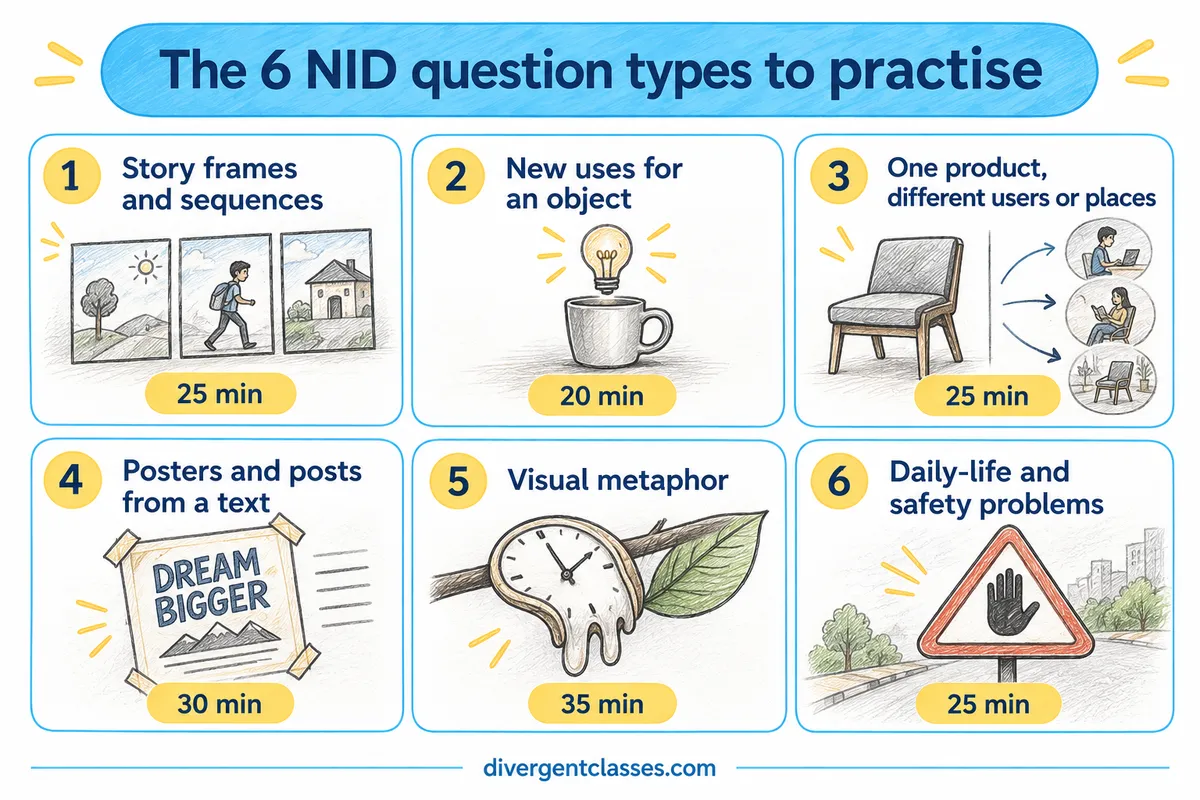
The 6 NID question types to practise
Recent NID Prelims papers keep returning to six kinds of tasks. If you can do each of them well in under 35 minutes, you'll be ready for the kinds of tasks NID has set recently.
| Question type | Where it appeared (memory-based) | What it tests |
|---|---|---|
| 1. Story frames and sequences | 2026: a folktale in 3 frames. 2024: step-by-step process sequences | Picking key moments, showing time and change |
| 2. New uses for an object | 2026: three uses for a rigid plastic object | Seeing what a shape can do, functional logic |
| 3. One product, different users or places | 2026: one bottle in 3 settings. 2024: a water carrier for people living in the mountains | User-centred thinking, product drawing |
| 4. Posters and posts from a text | 2026: Instagram posts on solar and lithium. 2025: a poster seen from a crow's point of view | Reading, forming a view, visual communication |
| 5. Visual metaphor | 2026: a hand with an object, as a metaphor | Abstract thinking, symbolism, drawing hands |
| 6. Daily-life and safety problems | 2026: children on a bus that brakes suddenly. 2025: leaves falling over a wall between neighbours | Spotting the real problem, practical solutions |
Sources: NID does not publish its papers. These tasks are memory-based, as reported by students to Careers360 (2024), Careers360 (2025) and Careers360 (2026).
NID's 2027 handbook doesn't promise these types, and says the structure of the exam can change. So treat them as practice targets, not a guarantee. Our NID DAT 2027 exam pattern guide explains what NID has and hasn't said.
Your 30-day NID plan
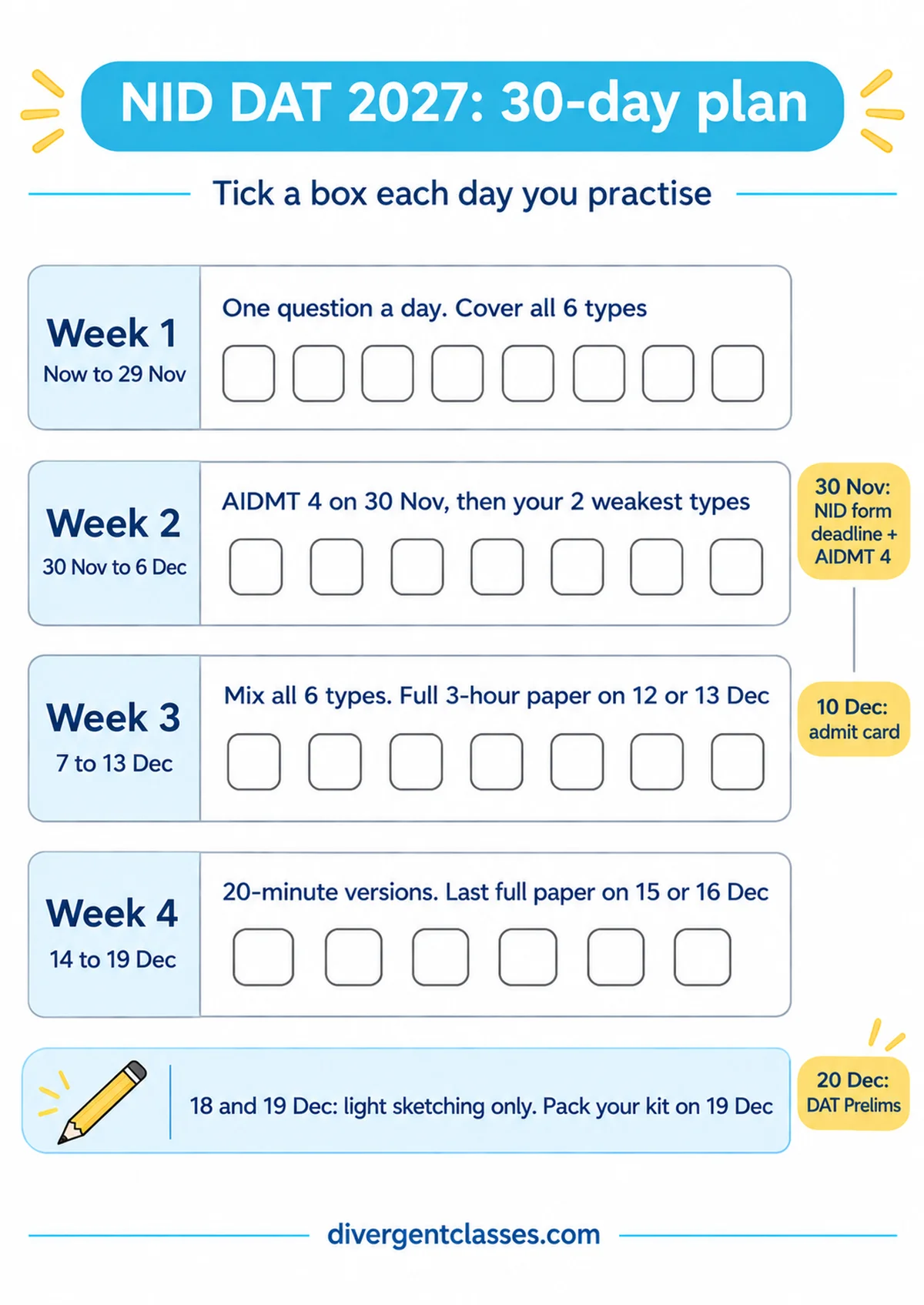
Practise one question type a day, take one full paper a week, and use AIDMT 4 on 30 November to find your weak spots. This plan is our recommendation. Start from whichever week you're in.
| Week | Daily practice | Full paper | Also do |
|---|---|---|---|
| Week 1: Today to 29 Nov | One question a day. Cover all 6 types once | None. Save your energy for AIDMT 4 | Submit your NID form before 11:59 pm on 30 Nov |
| Week 2: 30 Nov to 6 Dec | 30 Nov: AIDMT 4. Then alternate your 2 weakest types | AIDMT 4 on 30 Nov | Form edit window: 1 to 3 Dec. Read your AIDMT feedback and list 3 fixes |
| Week 3: 7 to 13 Dec | Mix all 6 types, with 2 extra days on each weak type | Your own 3-hour paper on 12 or 13 Dec: pick 6 questions, one per type, from the bank below | Admit card on 10 Dec: check your centre, reporting time, duration and allowed items |
| Week 4: 14 to 19 Dec | Shorter 20-minute versions. Redo answers that scored low on your self-check | One last full paper on 15 or 16 Dec, at the time printed on your admit card | 18 and 19 Dec: light sketching only. Pack your kit on 19 Dec |
| Exam: Sun 20 Dec | DAT Prelims | — | — |
Starting late? If you have less than four weeks
The plan still works. Join it at the week that matches today's date and keep its order: find your weak types, take a full paper, then fix them.
- About 3 weeks left (from 30 Nov): start at Week 2. Take AIDMT 4 or your own full paper first, so you know your weak types straight away.
- About 2 weeks left (from 7 Dec): start at Week 3. Do one question of each type in the first three days, then spend the rest on your two weakest.
- Under a week left (from 14 Dec): follow Week 4 only. Do one full timed paper, redo your two weakest types, and keep the last two days light.
A daily routine that fits around school
About 60 to 80 minutes a day is enough if you use it well. Here is the routine we recommend:
- Warm up (10 minutes): draw one everyday object from memory, then check it against the real thing.
- One timed question (25 to 35 minutes): pick today's type from the plan. Set a timer and stop when it rings.
- Self-check (10 minutes): mark your answer against that type's checklist below. Write one fix for tomorrow.
- Quick objective practice (15 minutes): paper folding, mirror images, pattern series and spotting details in logos. This covers you in case NID brings back an objective section.
You don't need 12-hour days. A short, timed, checked question every day builds more skill than long untimed sessions.
Why this plan works
Three well-studied learning principles sit behind it. None of these studies looked at NID or design exams, so read them as general principles.
- Practise by testing yourself, and spread it out. A large review rated practice testing and spaced practice as two of the most useful study methods (Dunlosky et al., 2013).
- Recall beats re-reading. Students who practised recalling material remembered more a week later than those who re-studied it (Roediger and Karpicke, 2006).
- Mix your question types. Mixing problem types during practice improved test scores in a maths study (Rohrer and Taylor, 2007). That's why the plan rotates types instead of doing one type all week.
NID practice questions by type
Here are 18 practice questions, 3 for each type. We wrote them ourselves in the style of recent papers; none is copied from an NID paper. Draw on A4 sheets with a pencil, set a timer, and check your answer against the list under each type.
1. Story frames and sequences (25 minutes each)
- A stray puppy slowly wins over a whole housing colony. Draw 3 frames that tell the story, with about 20 words under each.
- Show how raw cotton becomes a school uniform in 4 steps. One sketch per step, with a label of up to 5 words.
- A girl plants a seed on her first day of school. Draw 3 frames that end on her last day of Class 12.
Self-check
- Do your frames tell the whole story without the captions?
- Can you see time or change in the drawing itself?
- Does your main character look the same in every frame?
- Is each frame easy to read at a glance?
- Do the captions add something the picture can't show?
2. New uses for an object (20 minutes each)
- An empty cardboard egg tray: show 3 uses outside the kitchen.
- An old bicycle wheel rim: show 3 uses inside a school.
- A wooden clothes peg, made ten times bigger: show 3 uses.
For each use, draw it being used and write about 20 words on why it works.
Self-check
- Are your 3 uses from 3 different settings?
- Is the object shown in use, with a hand or a setting?
- Did you say why its shape suits each use?
- Would each use work without changing the object much?
- Are your lines clean and your labels clear?
3. One product, different users or places (25 minutes each)
- An umbrella for a street vendor, a cyclist and an elderly person who uses a walking stick.
- A water bottle for a Class 1 child, a hostel student and a cricketer at net practice.
- A torch for a farmer in a field at night, a child who is scared of the dark, and a hospital ward during a power cut.
Draw one clean view of the product for each user, with no background, and label the change you made.
Self-check
- Did you name a real need for each user?
- Does your change solve that need, and is it visible on the product?
- Is it still clearly the same product in all three versions?
- Did you keep to clean views, with no background?
- Are proportion and perspective believable?
4. Posters and posts from a text (30 minutes each)
- Read this: "Most tea stalls in your city now serve tea in single-use plastic cups. They are cheap and quick, but many end up in drains. Clay cups cost more and break easily." Write your opinion in 3 sentences, then design 3 Instagram posts, each with a sketch and a short caption.
- Design a poster for a new reading corner in your school library, seen from the point of view of a book on the shelf.
- Your city faces a water shortage this summer. Design 3 posts that get families to save water at home.
Self-check
- Is your opinion short and fair to both sides?
- Can you state each post's message in one line?
- Would each post be readable on a phone screen?
- Do the posts look like one series?
- Does at least one caption tell people what to do?
5. Visual metaphor (35 minutes each)
- An eye and a key. Give it a title and write about 50 words on what it means.
- A shoe, with one of these: a clock, a feather or a chain.
- A tree and a mobile phone.
Self-check
- Is the idea clear before anyone reads your title?
- Did you add one twist, rather than a crowd of objects?
- Are the objects drawn convincingly, with good proportion?
- Does the title add meaning, not just name the objects?
- Did you stay within the word limit?
6. Daily-life and safety problems (25 minutes each)
- People waiting at a bus stop get splashed when vehicles drive through a puddle. Suggest 3 ideas.
- Many elderly people can't read the small print on medicine strips. Suggest 3 ideas.
- Hundreds of students crowd the school gate at closing time. Suggest 3 ideas to make it safer.
For each idea, draw a person using it and write about 20 words on how it helps.
Self-check
- Did you name the exact moment or cause of the problem?
- Are your ideas at different levels: a product, a change to the space, a system or rule?
- Could each idea realistically be built or used here?
- Did you show a person using each idea?
- Did you follow every condition in the question?
How to check your own answers
Wait 10 minutes after the timer rings, then mark your answer against its 5-point checklist: 2 for yes, 1 for partly, 0 for no. That gives a score out of 10. This scoring is our method, not NID's, but it shows you clearly what to fix tomorrow.
Keep every sheet in one folder with its score on top. After week 1 and AIDMT 4, you'll see which types keep scoring below 6. Make the two lowest your weak types for weeks 2 to 4.
Self-checking has a limit: you can't easily spot your own blind spots. Swap sheets with a friend once a week, or get a mentor's eye on at least one full paper before 20 December. AIDMT 4 on 30 November is one way to get it.
Your checkpoint: AIDMT 4 on 30 November
- What: an all-India NID DAT mock by Divergent Classes. It follows the real NID DAT Prelims pattern, so it works as your week-2 full paper.
- When: 30 November 2026, 9 am to 11:59 pm IST. Attempt it online on a laptop or desktop, draw on paper and upload a photo. One attempt.
- Checked by: Divergent mentors from IIT Bombay and NID Ahmedabad. Each criterion is marked out of 10, with written feedback on every drawing, so you know exactly which types to fix in weeks 3 and 4.
- You get: your all-India rank among AIDMT participants and a topic report. Result date will be announced soon.
- Fee: ₹199, or ₹399 for a group of 3.
- Before you start: 30 November is also NID's last date to apply. Submit your NID form first.
Register for AIDMT 4 → · See all AIDMT dates
AIDMT is an independent mock test by Divergent Classes. It is not run, approved or endorsed by NID.
Want a mock-by-mock plan instead? Our NID DAT mock test 2027 plan shows how to compare two mocks, and the AIDMT 2027 guide explains the scorecard.
Last-month mistakes to avoid
These are the habits we see hurt students most in the final weeks. This is our advice, not exam data.
- Learning new techniques now. A month out, sharpen what you can already do. Don't switch to a new medium or style.
- Practising only the types you enjoy. Your weakest type is where the easiest marks are hiding.
- Practising without a timer. An answer that takes 50 minutes at home won't fit in 25 minutes in the hall.
- Not reading your feedback. If the same checklist point scores 0 three times, that is your fix for the week.
- Cramming GK lists. Fifteen minutes of objective practice a day is enough cover.
- Cutting sleep before the exam. Tired hands draw shaky lines.
The day before and exam day
No new practice the day before. Pack your kit, check your route and sleep early.
What to carry (check your admit card first). NID prints the allowed items on the admit card, released on 10 December. For the 2026 Prelims, students and exam sites reported these:
- A printed admit card and an original photo ID
- Lead pencils of a few grades, an eraser and a sharpener
- Dry colours, such as colour pencils or oil pastels
- A ruler
Answer and drawing sheets were provided at the centre. Sharing stationery wasn't allowed, and bags and phones had to stay outside. If your admit card says something different, follow the admit card. Carry a spare pencil and eraser, and keep a spare printout of your admit card.
In the hall.
- Spend the first 5 minutes reading the whole paper and noting the marks for each question.
- Give each question time in line with its marks. In a paper like 2026's (reported as 100 marks in 3 hours), that's about 1.6 minutes per mark, with time left to read and check.
- When a question asks for three ideas, give three, even if the third is simpler.
- Keep 10 minutes at the end to add labels and finish explanations.
FAQs
Is 1 month enough to prepare for NID? It's enough to improve a lot, especially if you already sketch regularly. It isn't enough to learn everything, so focus on the 6 question types and timed practice. Remember the Prelims only shortlists: NID calls 2.5 times the seats in each category to Mains.
How many hours a day should I practise? About 60 to 80 focused minutes on school days, plus a full 3-hour paper once a week. Steady daily practice beats occasional long days.
Should I still study GK for NID 2027? NID's 2027 handbook doesn't mention a GK or objective section, and the 2026 paper had none. Fifteen minutes a day of visual reasoning and observation practice is enough cover.
What drawing materials should I practise with? The same ones you'll carry on exam day: a few grades of pencil, an eraser, a sharpener and colour pencils or oil pastels. Use colour only where it's quick and adds meaning.
I'm not great at drawing. Can I still clear the NID Prelims? Clear ideas and readable sketches matter more than polished art. Practise simple figures, hands and everyday objects for 10 minutes every day, and let your ideas do the work.
Stuck on one question type? Talk to a mentor about where you stand and what to do next. It is free. Our 75-Day Crash Course NID Live and Mentor plans continue for about 60 days after the Prelims, to prepare you for the Studio Sensitivity Test and the in-person round. Book a free call · Explore courses
Sources
- NID Admissions Handbook 2027-28: dates (section 3), Prelims format (8.2), shortlisting (8.4, 9.3)
- Memory-based papers: Careers360 (2024), Careers360 (2025), Careers360 (2026)
- Items reported for the 2026 Prelims: Shiksha, exam-day guidelines, Careers360, things to carry
- Learning research: Dunlosky et al., 2013; Roediger and Karpicke, 2006; Rohrer and Taylor, 2007
Keep reading
 NID DAT
 2027 Exam Pattern: Will Part A Come Back?
The 2026 NID paper had no Part A, and NID's 2027 handbook doesn't mention one. What NID does and doesn't say about the 20 December Prelims, the 2.5x Mains shortlist, and a plan for both outcomes.10 min read D-SAT
D-SAT 2027
D-SAT 2027 results: 918 students registered for the free UCEED and NID scholarship mock by Divergent Classes. Paper pattern, toppers, scholarships and D-SAT Wrapped, explained.8 min read UCEED
What's a Good Score in a UCEED Mock?
What's a good UCEED mock score? Real data from 347 students who took the D-SAT 2027 UCEED paper in October 2026: 117+ out of 300 was top 25%, 145+ was top 10%. Plus NID mock scores out of 100.7 min read